

Implant-Supported Dentures vs. Traditional Dentures: A Side-by-Side Comparison
Losing several or all of your natural teeth can feel like losing a piece of your identity, and the moment your dentist mentions dentures, a flood of questions usually follows. Will they slip when you laugh at dinner? Will you have to relearn how to speak? Will they feel like your own teeth again, or like something borrowed? These worries are valid, and they deserve honest, thorough answers rather than a one size fits all recommendation. At Haratz Dental, we walk patients through every option available before recommending a path forward, because the right choice depends on your bone density, your lifestyle, and how much you want your new teeth to feel permanent. Two of the most common paths our patients weigh against each other are traditional removable dentures and implant-supported dentures, and understanding how each one works, feels, and holds up over time can make the decision far less overwhelming. If you are exploring dentures and partial dentures as a solution for missing teeth, here is how the two approaches actually compare.What Sets Traditional Dentures Apart
Traditional dentures rest directly on the gums and are held in place with a combination of suction, adhesive, and the natural contours of your jaw. For patients missing all of their teeth in an arch, a full denture is custom molded to fit snugly against the gum ridge, while a partial denture clips onto remaining natural teeth to fill in the gaps. Modern materials have come a long way, and today’s dentures are lighter and more natural looking than the ones many people remember from past generations. The fact that traditional dentures do not require surgery makes them a faster and more budget-friendly option for many patients seeking a quicker return to a full smile. That said, they rely entirely on the gum ridge for support, and as the jawbone naturally continues to shrink after tooth loss, a traditional denture that fit well at first can start to loosen, shift, or cause sore spots over the following years without ongoing relines and adjustments.How Implant-Supported Dentures Work
Implant-supported dentures take a different approach by anchoring the prosthetic directly to the jawbone. During this process, we place a small number of dental implants, titanium posts that act as artificial tooth roots, into the jaw, and the denture then snaps or screws securely onto those implants rather than resting loosely on the gums. As the implants fuse with the bone over time, they provide a level of stability and biting force that traditional dentures simply cannot match. Patients who choose implant-supported dentures also benefit from the way the implants help preserve the jawbone itself. Thanks to the posts stimulating the bone the same way natural tooth roots once did, they can slow the bone loss that often continues after conventional dentures are placed. For patients missing an entire arch of teeth, we may also recommend dental implants placed using an All-on-4 style approach, which places as few as four strategically positioned implants to support a full, fixed arch of teeth.Comparing Comfort, Stability, and Long-Term Value
Choosing between these two options often comes down to how a patient prioritizes upfront cost, treatment time, and long-term comfort. A recent study of edentulous patients found that those with implant retained overdentures reported dramatically higher overall satisfaction than those wearing conventional dentures, with nearly half rating their implant-supported option as very satisfying compared to a small fraction of conventional denture wearers. That kind of gap in daily comfort is worth weighing carefully before committing to either path. A few of the differences our patients notice most often include:- Traditional dentures: typically cost less upfront and do not require any oral surgery, though they may need periodic relines as the jaw changes shape.
- Implant-supported dentures: involve a surgical placement phase but offer a level of chewing stability and stay in place confidence that most patients describe as life changing.
- Implants: help preserve jawbone density over time, while traditional dentures do not slow the natural bone resorption that follows tooth loss.
Haratz Dental Is Here to Help You Decide
Choosing between implant-supported and traditional dentures is a personal decision, and it deserves more than a quick answer. Dr. Adela Haratz has spent more than three decades helping patients throughout Aventura restore their smiles with treatment plans built around digital scanning, detailed imaging, and an unhurried, one on one approach to diagnosis, so every recommendation is based on your mouth rather than a generic template. If you are ready to talk through which type of denture fits your life, Dr. Adela Haratz and our team are ready to sit down with you and map out a plan that feels right from the very first appointment. Reach out through our contact form to schedule a consultation and take the next step toward a smile that feels like your own again.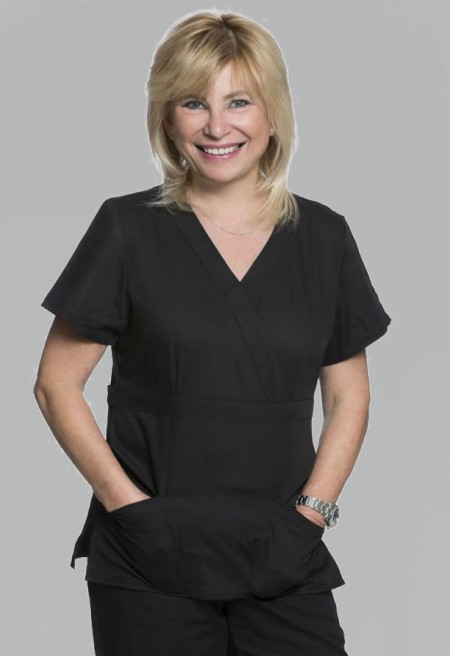
Written & Reviewed By
Dr. Adela Haratz, DDS
Dr. Adela Haratz is the founder of Haratz Dental and has more than 40 years of experience in dentistry. She is recognized as an aesthetic and scientific authority in dental artistry and facial aesthetics, and fellow dentists regularly turn to her for continuing education.
She earned her degree from the University of Miami and opened her private practice in Aventura in 2010. A member of the American Dental Association and the American Academy of Cosmetic Dentistry, Dr. Haratz focuses on veneers, smile design, full mouth rehabilitation, and root canal therapy. She and her team care for patients in English, Spanish, and Hebrew near Aventura, FL.